
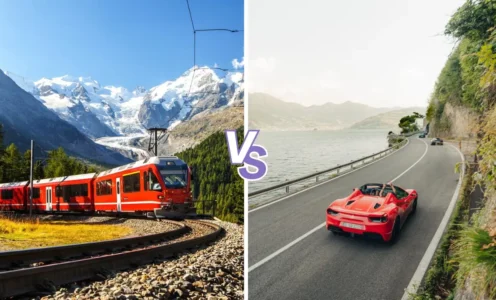
Train vs Car Travel in Northern Italy: Which One Is Actually Worth It?

Northern Italy has a way of making you feel like every direction you turn is worth a photograph. The Dolomites stacking up against a cobalt sky. Lake Como shimmering between mountain slopes. Vineyards rolling out across the Piedmont hills like a green and gold quilt. Verona’s terracotta rooftops glowing in the late afternoon sun.
The question isn’t whether to go. The question is how to move through it once you’re there.
And this is where travelers split into two very passionate camps: the ones who swear by Italy’s trains, and the ones who won’t give up their rental car for anything. Both sides have a point. Both sides also have blind spots.
I’ve done it both ways. Here’s the honest truth.
The Case for Taking the Train
Let’s start here, because Italy’s rail network — particularly in the north — is genuinely one of the better arguments for leaving the driving to someone else.
The connections are excellent. Milan, Venice, Verona, Bologna, Turin, Padua, Bergamo — these cities are linked by fast, frequent, comfortable trains. The high-speed Frecciarossa service between Milan and Venice takes about two and a half hours and drops you right in the heart of both cities. No airport-style security, no traffic jams on the A4, no circling a parking garage for forty-five minutes.
It’s relaxing in a way driving simply isn’t. You sit down, you watch the Po Valley slide past your window, you drink an espresso from the dining car, and you arrive. Your travel becomes part of the experience rather than a task you have to get through. There’s something deeply civilized about pulling into Santa Lucia station in Venice and stepping off a train directly into one of the most beautiful cities on earth.
The cost can surprise you. Book early — and I mean weeks in advance if possible — and you can find Frecciarossa tickets between major cities for surprisingly little. Compare that to a rental car, fuel, tolls on the autostrada (which add up fast), and city parking fees that will genuinely make you want to sit down, and the train starts looking very attractive indeed.
You can drink. This sounds frivolous until you’re in Barolo country or sitting on a terrace in Bardolino with a glass of something wonderful in front of you, and you remember that you have to drive back. The train doesn’t care how much Amarone you had at lunch.
But the Train Has Its Limits
Here’s where the train evangelists tend to go quiet.
Northern Italy is not only its great cities. It’s also the villages — the tiny, gorgeous, impractical-to-reach villages — perched on hillsides above Lake Garda, tucked into Alpine valleys, scattered across the Langhe wine region. And the train does not go there.
The rail network connects the major centers beautifully, but once you want to wander, to stop somewhere on a whim, to follow a road up into the hills because it looked interesting — the train can’t help you. You’re looking at buses with infrequent schedules, expensive taxis, or simply not going.
The Cinque Terre is an exception, yes. The train works brilliantly there (though the Cinque Terre is technically Liguria, not northern Italy proper). But much of what makes this region extraordinary — the back roads through Franciacorta wine country, the drive along the western shore of Lake Como, the mountain passes in the Dolomites — requires wheels of your own.
Train stations are also not always where you want to be. The station in a small Italian town can be a twenty-minute walk or a taxi ride from the actual town, the actual hotel, the actual reason you’re there. That’s manageable, but it’s worth knowing.
The Case for Renting a Car
A rental car in northern Italy is freedom. Pure, uncomplicated, map-the-route-yourself freedom.
You go where you want, when you want. The Dolomites, almost certainly the most spectacular mountain range you’ll ever drive through, are essentially a car-traveler’s dream. The Great Dolomites Road between Bolzano and Cortina d’Ampezzo is one of those drives that people describe as life-changing, and they’re not being dramatic. Switchbacks, vertiginous drops, rock walls that turn color in the light — you simply cannot experience this by train.
The Lake District — Como, Maggiore, Garda, Orta — is also dramatically better by car. These lakes have two sides each, and only one side of each lake typically has decent train access. Driving lets you circle the whole thing, stop in little towns that see ten tourists a year, find a restaurant with no English menu and eat the best meal of your trip.
Wine country is made for driving (when done responsibly, of course). The Langhe hills in Piedmont, the Valpolicella region near Verona, the Franciacorta sparkling wine zone near Brescia — these places are a patchwork of country roads between family estates and small producers who don’t have a TripAdvisor page and don’t need one. A car gets you there.
Flexibility is underrated. When you travel by train, you build your itinerary around departure times. When you travel by car, you build it around yourself. If you stumble upon a village market you didn’t know about, you stop. If you want to stay an extra night somewhere, you stay. The rigidity of a train schedule disappears.
Where It Gets Complicated: Driving in Italian Cities
Here’s the thing nobody tells you before you confidently book the rental car for your Italy trip.
Italian cities — particularly historic centers — are largely off-limits to private vehicles. The ZTL, or Zona a Traffico Limitato, is a restricted traffic zone that covers the historic heart of nearly every Italian city of any size. Drive into one without authorization and a camera will photograph your plate, and a fine will find you — sometimes weeks later, forwarded through your rental car company with an administrative fee tacked on.
Milan, Verona, Bologna, Turin, Bergamo’s upper town — all have ZTL zones. Navigating around them, finding parking outside them, and getting into the city center on foot or by local transport adds a layer of logistics that can quickly sap the joy out of arriving somewhere.
This is precisely where the train shines. You arrive at the station, which is almost always near or inside the historic center, and you walk. No parking. No fines. No circling.
The Honest Verdict: It Depends on Your Trip
Rather than declare a winner, here’s a more useful way to think about it.
Take the train if your trip is primarily city-focused — Milan, Venice, Verona, Bologna, Turin. These cities are well-connected, driving into them is more hassle than it’s worth, and the train will deliver you exactly where you need to be.
Rent a car if you’re planning to explore the countryside, the lakes beyond the main towns, the Dolomites, or the wine regions. The freedom is worth the logistical trade-offs, and some of northern Italy’s greatest experiences are only accessible this way.
Do both if you have the time — and this is genuinely my recommendation for a longer trip. Take the train between major cities. Pick up a rental car for a few days when you want to get rural. Drop it before you head into a city again. Many rental agencies operate across multiple cities so you can pick up in one place and drop off in another.
A Few Practical Notes Before You Go
Book trains early. Italian high-speed trains have dynamic pricing like airlines. The same seat that costs €25 booked six weeks out can cost €80 the week before.
Get a GPS or use your phone offline. Google Maps works well in Italy, but mobile data in rural mountain areas can be unreliable. Download your regions offline before you go.
Understand the autostrada toll system. Italy’s motorways are excellent but come with tolls. Keep change or a card handy at the booths, or look into a Telepass device through your rental company for ease.
Validate your train ticket. On regional (non-high-speed) trains, you may need to stamp your ticket in the yellow machines on the platform before boarding. Forgetting this is a fine waiting to happen.
Petrol stations in rural areas close on Sundays. Italy runs on its own schedule, and that schedule takes Sundays seriously. Plan accordingly.
Northern Italy rewards the traveler who moves through it slowly, who takes detours, who finds the table with no tablecloth in a village where the cook comes out to explain the menu. Whether you get there by train or by road, the place will do the rest.
Just maybe don’t try to drive through Venice.
Buon viaggio — however you choose to travel.